
Interpretation of First Rule of Love
Let us begin The Sweet Blasphemy!!!
This is my interpretation of Rule Number 1 of The Forty Rules of Love —
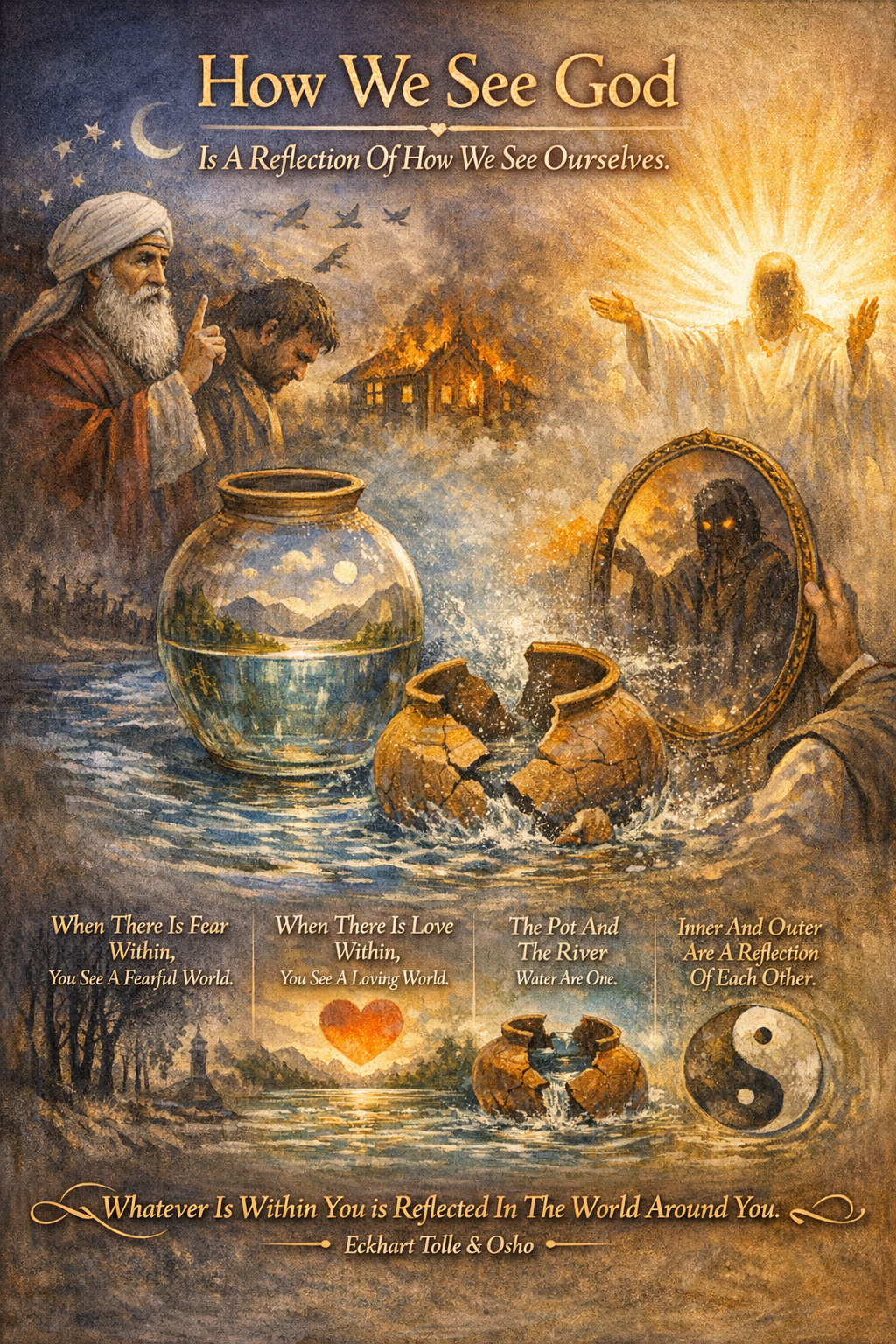
Rule Number 1 — How we see God is a direct reflection of how we see ourselves. If God brings to mind mostly fear and blame, it means there is too much fear and blame welling inside us. If we see God as full of love and compassion, so are we.
– Shams to the innkeeper
Context — Since this is Rule Number 1, it appears right at the beginning of the book. Here, Shams-e-Tabrizi is speaking to a tavern innkeeper, who happens to express his resentment toward God’s inability to protect and safeguard his own children.
It is at this moment that Shams narrates this aforementioned First Rule of Love.
Interpretation as per the context of the story — As we move forward in the book, we learn that the innkeeper lost his pregnant wife in a fire incident. He felt that, as a husband and father, he has failed as he was supposed to safeguard his family. He carried deep guilt over his inability to do so.
And it is this same sense of inability that he projects onto God — that God does not protect and safeguard His own children.
Now, this first rule by Shams makes profound sense.
Now, let us explore some other important interpretations beyond the context of the story —
1. From here onward, please understand the inner world as the separated Self and the outer world as existence or the Divine.
2. The human mind functions through divisions. It needs to divide things into parts and sub-parts to understand them. Hence, it divides even existence into inner and outer. In reality, there is no division anywhere in existence.
3. The best example I can offer is that of a few clay pots floating in a river, filled with river water. If we observe without creating divisions, the water inside the clay pots and the water outside in the river are one and the same. There is no real distinction between them. However, the borders or boundaries created by the clay pots give us the illusion of separation. It creates the feeling that the water inside the pot is separate from the water outside it.
4. An even simpler way to understand this is to imagine a clay pot breaking while still inside the river. Would we then be able to distinguish between the water inside and outside the pot? The entire body of water would be one, would it not?
5. Likewise, the clay pot we live in — the body — gives us the idea of separation: that “I am separate from everything else.” This body, ruled by the mind, creates the distinction between inner and outer, but in reality, everything is one. We realize this only when our clay pot (the body) is destroyed.
6. Once we are able to realize and see this clearly, we understand that the outer can never be different from the inner. Whatever I feel within myself, I project onto the whole of existence or the Divine — much like the tavern innkeeper did.
7. How many times do we say or hear statements like, “Anyone facing my difficulties or living in my situation would have committed suicide”? But how do you know how anyone else in the world would act or respond to the same situation? Just because a person feels suicidal due to his circumstances, he may begin projecting that mindset onto everyone else in the world.
8. Here, I have empathy for the struggles people face in their lives, but there is no point in projecting one’s own mindset onto the whole of existence.
9. Similarly, we project all our inner emotions and feelings onto the outer world. If I am full of doubt within myself, I will not be able to trust anyone in this world. If I deceive others, I may project onto everyone around me that they are deceptive. Just as the innkeeper’s inability to save his family was projected onto God as God’s inability to safeguard His people.
10. Eckhart Tolle expresses the same truth in these words: “The fact is: Whatever you think the world is withholding from you, you are withholding from the world.”
11. Osho also says that: “The World Is A Mirror. If you are Peaceful the whole World becomes Peaceful to you . It is just a reflection . Whatsoever you are is Reflected all over. Everyone becomes a Mirror."
12. If we are able to drop this dividing mind, we will see that the outer and the inner are one. We will then realize that we were unnecessarily projecting our own understandings — or misunderstandings — onto the Divine.
Gratitude!!!


Leave a Reply