
Interpretation of the Twenty-Ninth Rule of Love
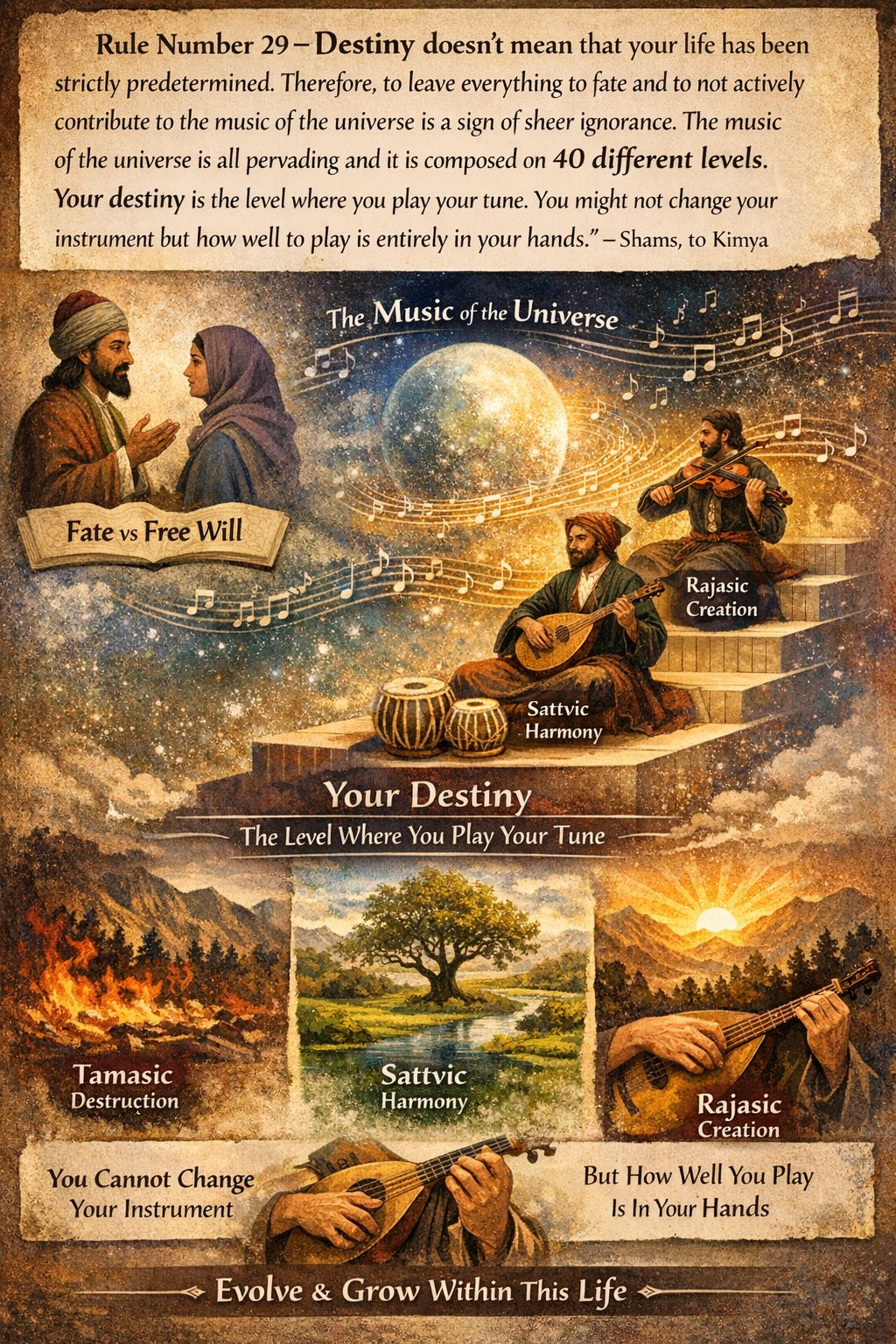
Rule Number 29 — Destiny doesn’t mean that your life has been strictly predetermined. Therefore, to live everything to the fate and to not actively contribute to the music of the universe is a sign of sheer ignorance. The music of the universe is all pervading and it is composed on 40 different levels. Your destiny is the level where you play your tune. You might not change your instrument but how well to play is entirely in your hands.
– Shams, to Kimya
Context - This rule emerges during a conversation between Shams and Kimya, where Kimya raises the timeless question of the human mind: Fate versus Free Will. In response, Shams shares this rule to express his perspective on the subject.
Interpretation within the Story - Before presenting this rule, Kimya asks Shams how she can grasp the deepest meaning of the Holy Qur’an. Shams replies that if it is in her destiny, she will understand. This response naturally leads the discussion toward the question of fate and free will, prompting Shams to articulate this insight.
According to Shams, destiny does not mean that events will unfold regardless of your effort. Instead, existence offers multiple possibilities for living at different levels of consciousness, and the level you choose becomes your destiny.
Deeper Interpretation Beyond the Story - In recent years, I have written extensively on the subject of Fate versus Free Will, so I will not repeat those ideas here. Instead, I will focus on interpreting Shams’ perspective through the lens of the Gunas of nature.
The first part of the rule is straightforward: destiny should not be misunderstood as an excuse for inaction, assuming that everything will happen on its own. In essence, the concept of destiny is closely related to surrender. However, as Osho points out, this idea is often misused by those who wish to avoid effort altogether.
This part of the rule clearly emphasizes that we must take appropriate action for destiny to unfold. In fact, a deeper realization is that what we perceive as “doing” is also part of “happening.” Our actions are themselves expressions of existence unfolding through us.
The second part of the rule can be better understood through the concept of the Gunas:
“The music of the universe is all-pervading and exists across forty levels. Your destiny is the level at which you play your tune. You may not be able to change your instrument, but how well you play it is entirely in your hands.”
Through my writings on the Gunas, I have explained that there are three fundamental ways of responding to life:
The creative way — Rajasic Guna
The sustaining or balancing way — Sattvic Guna
The destructive way — Tamasic Guna
Every action in life is influenced by one of these three Gunas. A person is naturally drawn toward activities aligned with their dominant Guna. For instance, a Rajasic person is inclined toward creation, a Tamasic person toward destruction, and a Sattvic person toward balance and harmony. This inclination arises automatically based on one’s predominant Guna.
Applying this understanding to Shams’ metaphor:
“The music of the universe” can be seen as universal energy.
“Forty different levels” suggests that this energy can manifest in many forms and degrees.
“Your destiny is the level at which you play your tune” means that you express this energy according to your dominant Guna.
When Shams says, “You may not change your instrument,” it can be understood as functioning within the same body and mind. However, this does not mean that transformation must wait for another lifetime. Evolution is possible here and now.
“…but how well you play is entirely in your hands” points to the possibility of growth within this very life. We can evolve by aligning our actions with higher Gunas, gradually moving toward greater awareness and balance.
Thus, even if a person begins life with a Tamasic inclination, they are not destined to remain so. The first step is awareness. Once a person recognizes their tendency, that very awareness, which is Sattvic in nature, becomes the catalyst for change. From there, they can consciously choose actions that are more Rajasic or Sattvic, leading to an overall transformation of their inner nature.
In this way, existence reveals a profound paradox: everything is destined, and yet the possibility of evolution rests within individual free will. It is as if life has been infused into an otherwise mechanical existence.
Gratitude!!!


Leave a Reply