
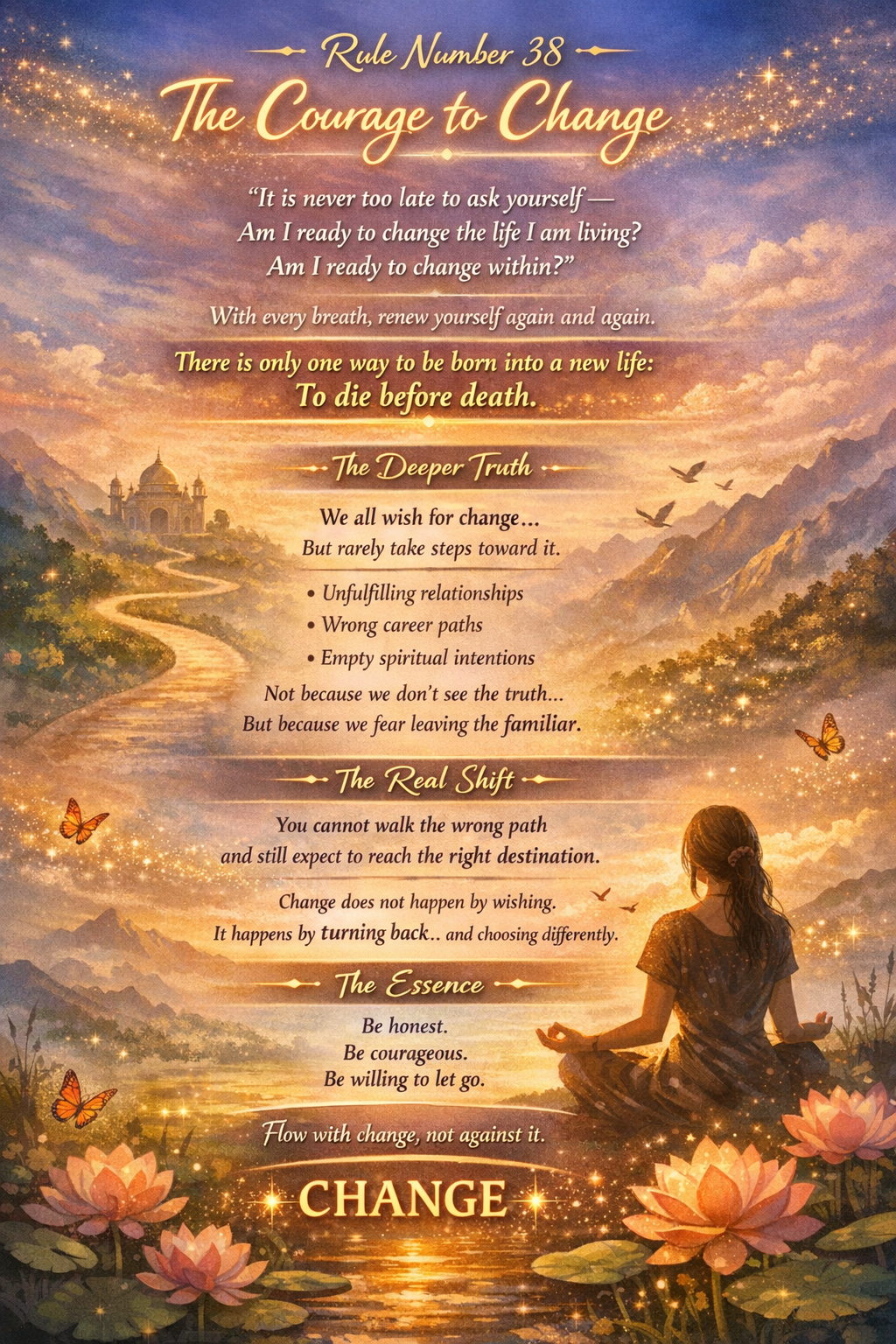
Interpretation of the Thirty-Eighth Rule of Love
Rule Number 38 — It is never too late to ask yourself,
“Am I ready to change the life I am living? Am I ready to change within?” Even
if a single day in your life is the same as the day before, it surely is a
pity. At every moment and with each new breath, one should be renewed and
renewed again. There is only one way to be born into a new life: to die before
death.
– Ella, to herself
Context – Alongside the story of Rumi and
Shams, The Forty Rules of Love presents a parallel narrative involving
Ella and Aziz. This particular rule emerges at a crucial turning point in
Ella’s life, when she finally gathers the courage to change the direction of
her existence. She decides to file for divorce, leave her family life behind
and begin a new journey with Aziz, fully aware that he is suffering from
stage-four cancer and may have barely a year and a half left to live. It is at
this moment of decision that she remembers this rule.
Interpretation within the Story – Ella, a woman in her
forties, had been living a stagnant and unfulfilling family life. Her marriage
had gradually lost its emotional meaning, and she was perhaps continuing with
it more out of habit, conditioning and social expectations than genuine affection.
Then she encountered Aziz, and as their connection deepened, affection and
emotional involvement developed between them.
After considerable hesitation, confusion and inner conflict, Ella
finally gathered the courage to accept what was happening within her and make a
decision. She chose to end her marriage and embrace an entirely different life,
despite knowing that her relationship with Aziz might be short-lived.
In this context, Rule Number 38 perfectly reflects Ella's journey. She was not merely changing her external circumstances; she was undergoing an internal transformation. She was willing to let go of the familiar life, with all its securities and conditioning, to experience something that felt more meaningful to her.
Deeper Interpretation Beyond the Story –
Whether it is personal, professional or spiritual life, we all desire
meaningful and fulfilling experiences. We want to experience happiness, love,
satisfaction and a sense of purpose. Whenever these experiences are missing
from our lives, we naturally begin to look for change.
However, this is where the paradox of the human mind comes into the
picture. We desire change, but we hesitate to take the necessary steps towards
it. We want transformation, but we expect it to happen on its own, almost
magically, without taking responsibility for our choices and actions.
Let us understand this through a simple example. Suppose you are heading
towards a temple but mistakenly take a road that leads you farther away from
your destination. What should you do? Obviously, you need to stop, turn around
and retrace your steps until you reach the correct path. You cannot continue
travelling on the wrong road and still expect to reach your destination on
time.
The same principle applies to our lives. Due to social conditioning,
fear, attachments and comfort zones, we often choose paths that do not lead
towards our desired destination. Even when we become aware that we are moving
in the wrong direction, we hesitate to take corrective action.
This pattern can be observed in almost every aspect of life:
Personal Life – Many people continue living in
unfulfilling or unhealthy relationships simply because they lack the courage to
walk away. They prefer the familiarity of an unhappy relationship over the
uncertainty of a new beginning.
Professional Life – Many individuals remain stuck in
unsuitable careers and professional environments because they are afraid of
losing financial security, social status or the identity they have built around
their profession.
Spiritual Life – People often express a desire to
connect with the Divine, understand existence or experience inner
transformation. Yet, they fail to dedicate even a reasonable amount of time and
effort towards the very pursuit they claim to value.
In all these situations, we desire positive change but resist taking
even the smallest steps required to bring it about.
Coming back to the story, Ella at least demonstrates a certain degree of
honesty towards herself. She acknowledges that her marriage has lost its
emotional meaning and that her involvement with Aziz has fundamentally changed
her relationship with her husband. Instead of pretending that everything is
normal and continuing the marriage merely for social appearances, she accepts
the reality of her situation and acts upon it.
Many people may argue that this is where the book conveys an
irresponsible attitude towards one's family and relationships. They may
question how Ella could leave her husband and children for someone she had
recently met, particularly when that person was suffering from a terminal
illness.
However, I look at this situation from a slightly different perspective.
Ella's responsibilities towards her husband and children were rooted in
her marriage and the family structure she had created. But when she became
emotionally involved with Aziz outside her marriage, she had, in a way, already
acknowledged that something fundamental had changed in her existing
relationship. Her marriage had become dysfunctional from an emotional
perspective.
Under these circumstances, what Ella eventually did — separating herself
from her husband and family rather than continuing the marriage for namesake —
can also be viewed as an honest and responsible decision.
Of course, this does not mean that responsibilities towards children or
other family members simply disappear when someone decides to change their
personal life. Those responsibilities continue and need to be fulfilled. But
there is a difference between fulfilling one's responsibilities and pretending
to be emotionally present in a relationship that has already lost its meaning.
In my opinion, the first responsibility we need to develop is honesty
and responsibility towards our own Self. This does not mean becoming selfish or
disregarding others. It means having enough courage to acknowledge what is
happening within us rather than living a life based entirely on social
expectations, fear and conditioning.
Another common argument is that this was merely a fictional story and
not a real-life situation. Well, I believe fiction often reflects realities
that people experience but hesitate to discuss openly. In times when marriages
are increasingly facing breakdowns and separation, we can find thousands of
real-life examples of people choosing to move away from emotionally dead
relationships in pursuit of a more meaningful life.
The circumstances may differ, and every individual situation needs to be
evaluated independently. But the underlying question remains the same: Should
we continue living a life that no longer reflects who we are simply because we
are afraid of changing it?
Overall, Rule Number 38 reminds us that
transformation begins with an honest question directed towards ourselves: Am I
ready to change?
It is not enough to recognise that something is wrong in our lives. We
also need the courage to take corrective action. Sometimes, this may mean
changing our surroundings, relationships, profession or lifestyle. At other
times, the real transformation may need to happen within our own minds and
understanding.
The most interesting part of this rule is the statement that there is
only one way to be born into a new life: to die before death.
I interpret this as the death of our old conditioning, attachments,
identities, expectations and fears. Unless we are willing to let go of the
person we have been, how can we become someone new?
We often associate death with the end of physical existence. But there
can also be an entirely different kind of death — the death of an old identity,
an old mindset and an old way of looking at life. This is perhaps the
transformation that Ella experiences in her journey.
Change is not an exception in life; it is the very nature of existence.
Everything is continuously changing, whether we acknowledge it or not. Our
relationships, circumstances, bodies, thoughts and understanding are all
evolving.
The only constant in existence is change.
So, perhaps the real question is not whether life will change, but
whether we are willing to change along with it.
Gratitude!!!


Leave a Reply