
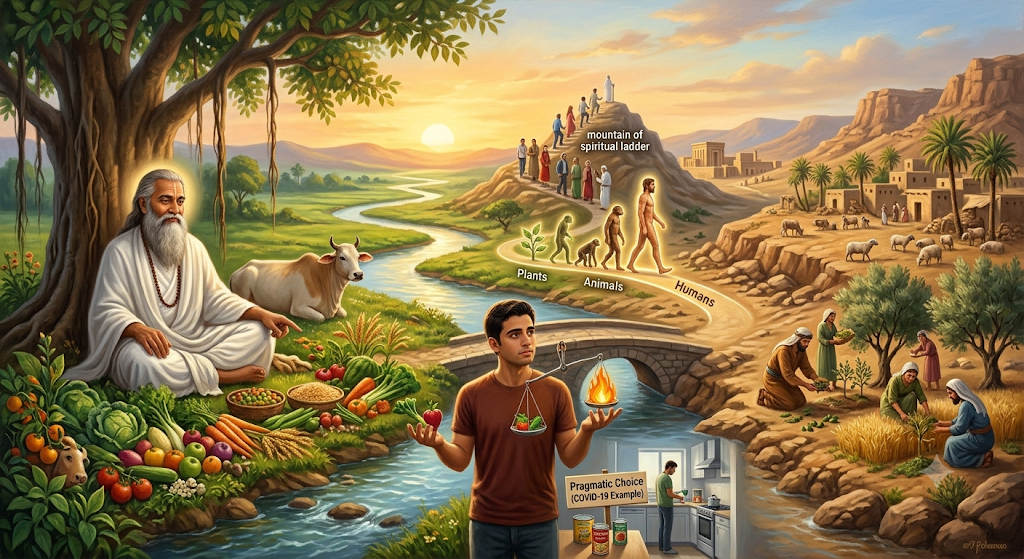
Vegetarian vs. Non-Vegetarian Diet: Geography, Consciousness, and Practical Wisdom
Few dietary topics spark as much passionate debate as the choice between vegetarian and non-vegetarian food. Across dinner tables, spiritual forums, and medical debates, every side brings compelling arguments to the table—ranging from nutrition, protein requirements, and personal taste to ethics, environmental impact, and spiritual evolution. To truly understand why these perspectives exist and how we should navigate them in modern life, we need to look beyond rigid dogma and examine the geography, evolutionary consciousness, and sheer practicality behind what we put on our plates.
Geography and the Roots of Religious Dietary Laws
A
common observation in comparative religion is that Eastern religions
(such as Hinduism, Jainism, and Buddhism) largely discourage or prohibit
non-vegetarian food, whereas Western religions (such as Judaism,
Christianity, and Islam) permit it. However, rather than being arbitrary moral
judgments, these dietary guidelines are deeply rooted in the geography
where these traditions were born.
- The
Lush East: Eastern
traditions originated in fertile, river-rich regions teeming with
greenery, agriculture, and year-round vegetation. When grains, vegetables,
and fruits were abundant, there was simply no practical necessity to kill
an animal for survival. Thus, non-violence (Ahimsa) naturally
became the standard.
- The
Arid West:
Conversely, Western religions largely took birth in harsh, arid desert
landscapes where agriculture was scarce and vegetation could not easily
grow. In an environment devoid of crops, survival depended on livestock
and meat. Allowing non-vegetarian food was a pragmatic necessity to
preserve human life.
On
a related note, this also seems to explain why funeral practices evolved so
differently—the Eastern world had abundant timber for cremation, while the
Western world had to rely on burial as its main option.
Yet,
if we look closely at Western scriptures, we find that a plant-based diet was
still recognized as the original ideal before scarcity dictated otherwise:
The Bible (Genesis 1:29–30):
"Then
God said, 'I give you every seed-bearing plant on the face of the whole earth
and every tree that has fruit with seed in it. They will be yours for food. And
to all the beasts of the earth and all the birds in the sky and all the
creatures that move along the ground—everything that has the breath of life in
it—I give every green plant for food.' And it was so."
The
Quran (Surah ‘Abasa, Chapter 80, Verses 24–32):
"Then
let mankind look at his food: How We pour down water in abundance, and split
the earth in clefts, and cause therein the grain to grow, and grapes and green
fodder, and olives and date-palms, and gardens dense with many trees, and
fruits and herbage—as a provision and benefit for you and your cattle."
In both traditions, the foundational blueprint favors vegetation first, permitting meat as a secondary provision for human sustenance.
The
Gunas of Nature and the Energy of Food
In
Eastern philosophy, food is not merely fuel for the physical body; it carries
subtle psychological and energetic qualities known as the three Gunas—Sattva
(purity, clarity, balance), Rajas (activity, passion, restlessness), and
Tamas (inertia, heaviness, lethargy).
As
explored in a recent Q&A discussion regarding diet and the Gunas of nature:
- The Tamsik
Effect of Heavy Foods:
Non-vegetarian food—and even excessively heavy, overly spiced vegetarian
food—increases Tamas in the body. One of the primary traits of Tamas
is drowsiness, heaviness, and mental fog. While we do need a baseline of Tamas
to rest and sleep, excess Tamas weighs down our spiritual and
mental clarity. The goal of spiritual growth is to gradually refine our
system from Tamas to Rajas, and ultimately toward Sattva.
- Absorbing
the Trauma of Slaughter:
Non-vegetarian food is born out of violence and aggression. At the moment
an animal is slaughtered, it is not in a state of peace—it is experiencing
intense fear, anger, panic, and a desperate struggle for survival. As Osho
famously noted, "You become what you eat." Consuming the
flesh of an animal that died in terror carries the risk of introducing
subtle impressions of fear, anger, and aggression into the human psyche.
Even if a habitual meat-eater no longer feels immediate physical lethargy,
the subtle energetic impact remains.
(Note: While people occasionally point to rare stories of enlightened masters who consumed meat or intoxicants without consequence, Osho compares such masters to a giant, exceptionally strong mountaineer who can effortlessly carry the baggage of four people up a steep peak. Enlightened masters operate beyond the mind at a superconscious level. Ordinary seekers, however, are still bound by the mind and body—trying to imitate a master's lifestyle without possessing their level of consciousness is like trying to speak like Krishna while still standing at Arjuna's level of confusion.)
The
Hierarchy of Consciousness and the "Plants Have Life" Argument
Whenever
vegetarianism is discussed on ethical grounds, one classic counter-argument
inevitably arises: "Even plants have life! If we shouldn't kill living
things, we shouldn't eat vegetables either."
It
is entirely true that plants possess life. In fact, from a deeper philosophical
lens, consciousness permeates everything in existence—even rocks hold a
dormant, foundational spark of life capable of supporting saplings. However,
nature operates on an evolutionary hierarchy of consciousness:
- Rocks
& Minerals: The
most dormant, foundational level of existence.
- Plants: A higher level of consciousness; they
grow, respond to sunlight, and sway, though they remain rooted in one
place.
- Animals: A significantly higher consciousness;
they possess nervous systems, feel complex emotions, and can actively move
from place to place.
- Humans: At the pinnacle of material
evolution, possessing self-awareness and the capacity to attain
enlightenment or superconsciousness.
Because of this evolutionary ladder, nature follows a clear hierarchy of preservation: to save a human life, an animal may be sacrificed; to save an animal's life, a plant may be sacrificed.
When
you have a clear choice between eating a plant and eating an animal, choosing
the plant causes less disruption to higher consciousness. However, if you are
placed in an extreme survival scenario where no plant food exists, human life
takes precedence. Consider the COVID-19 lockdowns: if someone were
stranded in an isolated location where no fruits, grains, or vegetables were
available, and meat was the only option to stay alive, consuming it would be
completely justified because preserving human consciousness is paramount.
Sensitivity
vs. Hypocrisy: Operating From Our True Level
Beyond
rules and hierarchies, dietary choices are ultimately tied to a person's inner sensitivity.
Great
masters like Mahavira and Gautam Buddha advised waiting until a
fruit ripens naturally and falls from the tree on its own before eating it,
rather than plucking it prematurely. Such teachings were not meant to be rigid
bureaucratic laws; rather, they reflected the extraordinary peak of sensitivity
these enlightened beings had reached—a state where they could literally feel
the subtle pain of a tree.
Today,
however, humanity suffers from a glaring contradiction. We are largely
insensitive to the pain and suffering of fellow human beings—which is
why devastating wars continue to rage across the globe simultaneously,
destroying humans, animals, and forests alike. We still burst firecrackers in
the name of religion and AQI crosses 3000 mark when elderly people, babies,
animals and plants are gasping for breath. When we cannot even cultivate basic
empathy for another human being regardless of caste, creed, race, religion, or
nationality, pretending to be deeply sensitive to the feelings of plants is
pure hypocrisy.
Sensitivity
must unfold naturally, step by step:
- First, develop genuine sensitivity and
compassion toward fellow human beings.
- Second, extend that sensitivity toward
animals.
- Third, once our consciousness naturally
refines to that height, we will organically develop sensitivity toward
plants and trees.
We should speak and act authentically from the level of consciousness we actually inhabit, rather than mimicking ideals we haven't yet lived.
A
Practical, Living Rule for Modern Life
Religions
and gurus lay down guidelines suited to the geography and era in which they
lived, but life itself does not follow rigid rules. Life is dynamic; it brings
unprecedented situations every single day, requiring us to respond with fresh
intelligence rather than blind conditioning. The desert regions where Western
religions originated are no longer barren wastelands cut off from global
agriculture. Similarly, when Buddha and Mahavira spoke of waiting for fallen
fruit, they were not addressing a modern urbanite trapped in a global pandemic
lockdown.
Therefore,
instead of binding ourselves to permanent dogma, we can live by a simple,
conscious, and adaptable principle:
- Honor
ecological coexistence and balance: Humans, animals, and plants are deeply interconnected
threads of a single living web; true harmony lies in taking only what is
needed so that all forms of life can thrive together.
- Value
life mindfully: Human
life holds the highest value. To save a human life, an animal can be
sacrificed; to save an animal, a plant can be sacrificed.
- Choose
consciously when options exist:
Whenever both vegetarian and non-vegetarian foods are available, prefer
fruits, grains, and vegetables to minimize violence and keep the body and
mind light.
- Adapt
for survival without guilt:
If an extreme circumstance leaves no option other than meat to sustain and
preserve your life, consume it for the time being.
- Remain open to life: Truth is not static. If life presents an entirely new reality tomorrow, we must always reserve the wisdom and freedom to rethink, adapt, and evolve our rules once again.
Gratitude!!!


Leave a Reply