
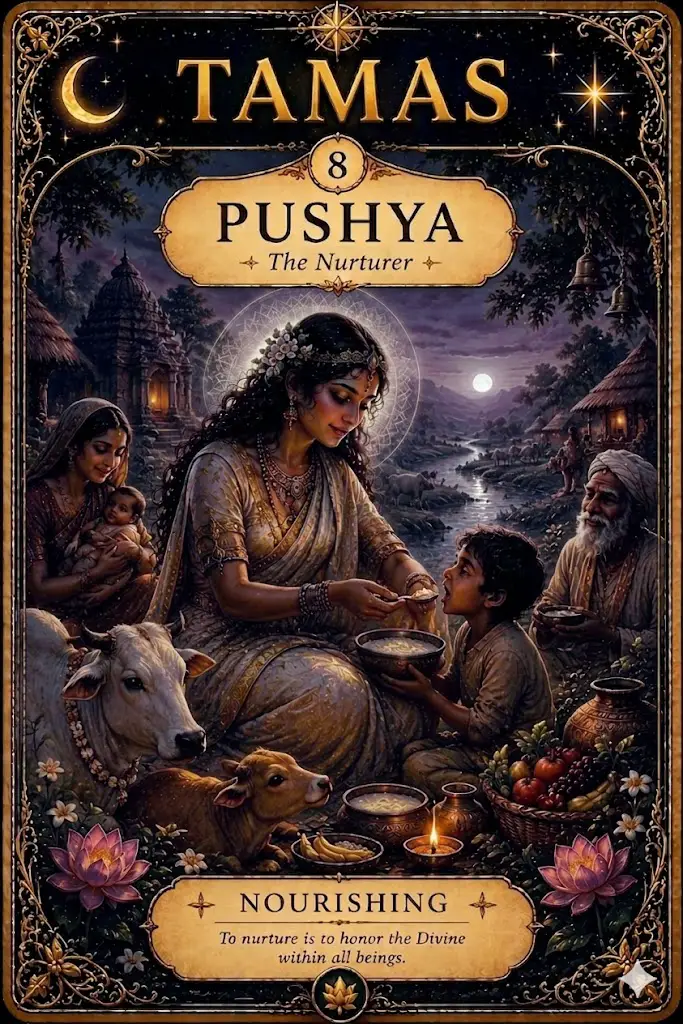
Card 8 :: PUSHYA - The Nurturer
Theme
Universal
Nourishment, the Pendulum of Desire, Selfless Adoption, and the Sublimation of
Intellect through Wisdom.
The Eighth Card:
The Infinite Sustainer - As Pushya stands as the eighth Nakshatra in the sacred
cosmic scheme, it naturally serves as the eighth card in this deck,
representing the exact same foundational energy.
In spiritual
numerology, the Number 8 is the number of cosmic balance, infinite power,
material mastery, and evolutionary cycles. It acts as a bridge between the
physical and spiritual realms, often taking on the role of the ultimate
protector and provider. While previous energies initiated, tested, or restored,
the Number 8 establishes a structure of supreme, unconditional nourishment and
duty. It signifies the absolute mastery of care, the ability to build enduring
security, and the selfless devotion required to feed, sustain, and fiercely
protect life through all its ups and downs.
Name and its
meaning – Pushya originates from the root word Poshan which means ‘To Nourish’
or ‘To Care’. Other meanings are also similar like Nourisher or Nurturer.
Mystical Imagery –
The main representation of this nakshatra is "Milk Yielding Cow's
Udder". Through its milk, Cow nourishes not only its Calf but others too.
Deity and
Nakshatra Lord – Main deity of Pushya
Nakshatra is Brihaspati or Jupiter. Nakshatra Lord is Saturn.
Mythology
The mythological story of Pushya Nakshatra centers on the cosmic conflict between Brihaspati (Jupiter), the Guru of the Gods, and Soma (the Moon God), which highlights themes of betrayal, divine protection, and selfless nurturing.
Here is the story
in short:
The Betrayal:
Tara, the beautiful wife of Brihaspati, grew lonely and neglected because her
husband was entirely consumed by his priestly duties and spiritual rituals. She
became intensely attracted to Soma (the Moon), who was radiant, romantic, and
charming. The two fell in love, and Soma abducted Tara, taking her to his
kingdom.
The Cosmic War:
Outraged by this violation of righteousness (Dharma), Brihaspati demanded his
wife back. Soma refused, leading to a massive celestial war between the gods
(who supported Brihaspati) and the demons (who sided with Soma). To stop the
universe from tearing itself apart, Lord Brahma intervened and ordered Soma to
return Tara to her rightful husband.
The Selfless
Nurturing: When Tara returned, she was pregnant with Soma's child, who would
grow up to be Budha (Mercury). Despite the infidelity and the complicated
circumstances, Brihaspati chose to put aside bitterness, accepting the child
and selflessly nurturing him as his own.
Because of this
myth, Pushya is deeply tied to nourishment, care, and the maternal or priestly
duty to protect and sustain life, even in the face of emotional crisis or
betrayal.
The Oracle Guidance
Pushya’s name
stems from Poshan, translating directly to "To Nourish" or "To
Care." Its structural physical emblem is The Milk-Yielding Cow’s Udder—a
symbol of life-giving fluid offered freely to sustain the world beyond the
attachments of "I, Me, and Mine."
The mythic
architecture of Pushya exposes the complex, unvarnished undercurrents of
relationship dynamics and mental conditioning. The high priest and Guru of the
Gods, Brihaspati (Jupiter), was so consumed by his dry spiritual rituals that
he entirely neglected his beautiful wife, Tara. Starved for attention and love,
Tara eloped with Brihaspati's best friend, the charismatic Moon. Their
passionate union produced a child: Mercury.
When the social
pressure of the Gods forced a vulnerable Tara to return, Brihaspati took a
revolutionary step. He looked past the public ridicule and adopted the infant
Mercury as his own son, proclaiming that a blameless child must never suffer
for the mistakes of the adults.
Pushya serves as
an extraordinary internal mirror: Where are you taking your loved ones for
granted, driving them to seek warmth elsewhere? Are you clinging to the
bitterness of betrayal, or are you ready to offer your care selflessly, without
conditions? Ruled by Saturn as its Nakshatra lord, Pushya demands immense
maturity. This card indicates a time to halt the pendulum of unfulfilled
desires, master your thoughts, and anchor your life force in true, uncorrupted
service.
The Tri-Guna Pathway
The complex triangle of Jupiter (wisdom), the Moon (mind), and Mercury (intellect) within Saturn's strict karmic field allows Pushya's energy to express itself across three distinct evolutionary bands of consciousness.
1. The Tamasic
Shadow: Neglect, Blame, and the Starvation of Love
At its lowest
frequency, Pushya descends into dry isolation, basic physical cravings, and
messy interpersonal betrayals.
The Oracle Mirror:
This is Brihaspati completely tuning out his partner to pursue remote
intellectual paths, leaving Tara emotionally starved at the dense body level
(Tamas). It is the blame game of whose mistake it was, hidden affairs, and the
sudden, defensive flight from reality.
In Your Life: In
Tamas, Pushya manifests as severe emotional neglect or taking your partner
completely for granted. If relationship planets sit here, it reveals an ongoing
danger of infidelity born out of feeling unloved. You become trapped in a
victim loop, weaponizing your support, or using manipulative tactics to secure
your own survival while ignoring the basic emotional hunger of those around
you.
2. The Rajasic
Bridge: The Restless Pendulum & the Cultivation of Gratitude
To move out of
Tamasic neglect, the mind must recognize its own patterns of chasing. Rajas
ignites the drive to look honestly at your desires and aggressively realign
your life.
The Oracle Mirror:
This is the pendulum-like swing of the human mind described by Osho. The moment
Brihaspati loses Tara, she suddenly becomes attractive again, forcing him to
run to the Gods for help. Meanwhile, Tara, having achieved a spiritual husband,
suddenly swings toward a romantic one.
In Your Life:
Rajasic Pushya exposes the chronic human tendency to devalue what you possess
and ache for what is out of reach. To cross this bridge, you must actively
practice radical gratitude. You channel Mercury's active intellect into
structured environments—running care institutions, building security, or
studying. You realize that if you constantly complain about what is missing,
existence will strip away even what you have.
3. The Sattvic
Light: Unconditional Adoption and Wise Thought
When the restless
mind is purified by absolute awareness, Pushya rises to its absolute
zenith—exalted wisdom providing universal, unselfish nourishment.
The Oracle Mirror:
This is Brihaspati adopting Mercury. Wisdom (Jupiter) adopts the thoughts of
the human mind (Mercury). Because thoughts precede action, placing your
intellect under the protective care of higher wisdom ensures that your
manifestations remain completely pure.
In Your Life: In
Sattva, you step into the archetype of the Universal Mother or Father. Your
capacity to nourish extends far beyond biological boundaries; you care for the
underprivileged, adopt children, or mentor lost souls without a single shred of
personal ego. You provide safety and emotional sanctuary because you understand
that true love means caring for others beyond the boundary of personal
attachment.
Navigating the Energy Through Awareness
Audit Your Neglect
(Tamas): If you are experiencing coldness or a threat of betrayal in your
relationships, look in the mirror. Ask yourself: "Am I playing the role of
an inactive, emotionally unavailable Jupiter?" Stop treating your anchors
as guaranteed fixtures. Address the foundational emotional needs of your life
before attempting higher spiritual leaps.
Halt the Pendulum
(Rajas): Notice when your mind enters the loop of chasing the next best thing.
Stop running after the illusion of the "perfect scenario." Anchor
yourself in the present through intense gratitude for your current assets,
relationship dynamics, and baseline security. Value what you hold, or watch it
slip through your fingers.
Adopt Your
Thoughts with Wisdom (Sattva): Let your higher consciousness (Jupiter) take
absolute charge of your intellect (Mercury). Strip away all selfish motives
from your deeds. Offer your energy, resources, and care to the world cleanly
and unselfishly.
Remember: The
absolute moment selfishness enters your actions, Pushya’s life-giving milk
turns sour.
Transcending to Nirguna: The Inexhaustible Source
The final, absolute evolution of Pushya is the complete dissolution of the doer, returning effortlessly to the Nirguna state—the attributeless absolute.
While the Moon,
Saturn, and Jupiter work together to create the perfect material and spiritual
ecosystem of foster care and teaching, Pushya's deepest spiritual lesson is one
of complete detachment. Brihaspati had to let go of his pride, Tara had to let go
of her restless swinging, and the Moon had to let go of his prize to restore
cosmic balance.
When your
awareness fully balances the three Gunas through Saturn's grueling trials, you
stop identifying as the noble caretaker, the unfaithful partner, or the
illegitimate child. You step completely back into the seat of the Witness,
realizing you are the boundless, inexhaustible reservoir from which all
nourishment flows. You possess nothing, you lack nothing, and you desire
nothing. You are the eternal, unconditioned peace that sustains the universe.
Actionable
Affirmation
"I refuse to
take my life or my loved ones for granted. I halt the restless pendulum of
desire and choose radical gratitude for the present. I bring my intellect under
the shelter of divine wisdom, nourishing the world around me without
conditions. I am the silent witness, complete, eternal, and free."
Osho’s Guidance
To be a mother is
very difficult. Only one who has arrived home can be a mother. To give birth is
very easy, it is just natural, biological; but to be a mother is something
spiritual.
The mummy would
like you to follow her, she would like to possess you, to make you become a
part, a precious possession to her. She will cling to you.
The mother will
help you to become independent. She will help you to become individual. She
will love you, but she will not try to force anything on you. She will give her
love to you, but will not give her knowledge to you. She will send you into the
world to find your own truth, to find your own life. She will not give you a
pattern or a mold. She will not structure you, she will simply help you,
whatsoever you can be.
The mother is just
the ideal, it rarely happens. Mummy you can find anywhere. The mother is just
the ideal, the utopian ideal, one who can give birth to your soul. Only a
Buddha can be a mother, or a Meera can be a mother, or a Krishna, or a Mohammed
can be a mother, only one who can give you your soul, your destiny.
Gratitude!!!


Leave a Reply