
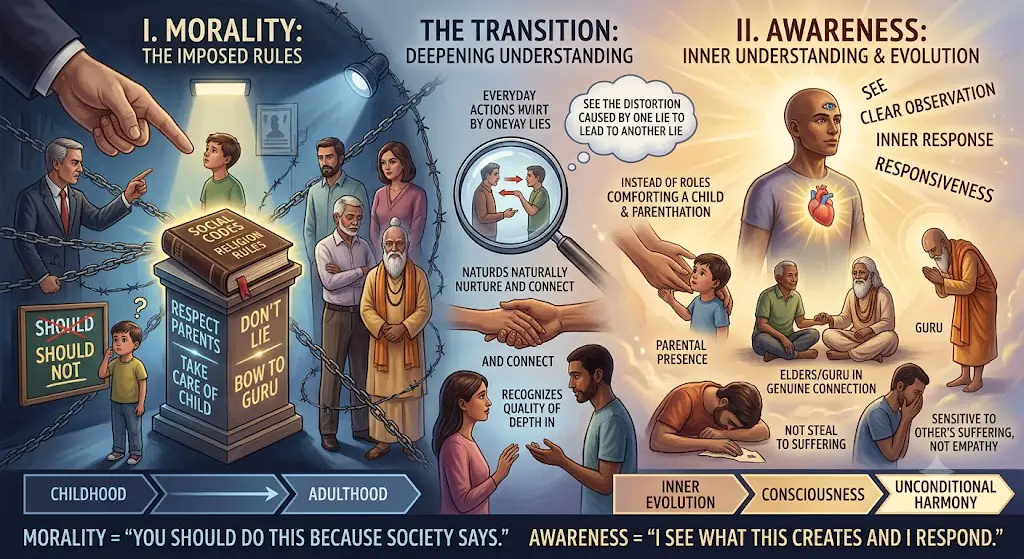
Moral Living Vs Conscious Living
There is a very subtle but important difference between Morality and Awareness. Morality is imposed from outside, whereas Awareness comes from within. Morality tells us what to do and what not to do. Awareness allows us to see what is happening and respond accordingly.
This difference may look small on the surface, but if we go deeper into it, we can see that these are two completely different ways of living life.
Morality Depends on Society
If we observe different societies, cultures and communities, we can see that their moral principles are not always the same. Something considered moral in one society may not necessarily be considered moral in another. This is because morality is largely created and transmitted by society.
From childhood, we are taught certain rules. We are told how to behave with our parents. We are told how to behave with elders. We are told what is right and what is wrong. We are told what we should do and what we should not do.
In this way, society creates a framework of acceptable behaviour and then teaches the individual to live according to that framework.
So, morality basically says: "This is right because society says this is right." & "This is wrong because society says this is wrong."
Awareness works differently.
Awareness does not necessarily need an externally imposed rule. Awareness is the result of becoming more conscious and more wakeful towards life. An aware person does not need to be given a rule for every possible situation. He sees the situation and responds according to his understanding.
Morality Says "Don't Lie", Awareness Understands Why?
Take a very simple example of lying. Morality may tell a child: "Do not lie." The child then learns that lying is morally wrong.
But awareness is something different.
As the person becomes more conscious, he begins to see what lying does within himself and within his relationships. He sees how lying creates distortion. He sees how one lie creates the need for another lie. He sees how lying separates him from reality and creates a split within Self.
At some point, there may no longer be any need for an external rule saying: "Do not lie." The person simply does not want to create an unnecessary distortion between himself and reality.
This is the difference.
Morality says: "Do not lie because it is wrong." Awareness says: "Why would I lie when I can see what lying creates?"
The outward action may look exactly the same. The inner source of that action, however, is completely different.
Morality Creates Roles, Awareness Recognizes Qualities
We can understand this difference even more clearly through relationships. Normally, we first define a relationship and then define the behaviour expected from that relationship.
For example, society says: A Father should take care of his child. A Mother should nurture her child. Parents and elders should be respected. A Guru should be bowed down to.
These are moral structures.
The relationship is defined first, and then certain actions are imposed on to that relationship.
Awareness looks at the matter from the other direction.
One who takes care of a child, protects the child and looks after the responsibilities related to the child is functioning as a Father, regardless of whether he has biologically fathered that child or not.
One who nurtures, loves and looks after a child is functioning as a Mother, regardless of whether she has biologically given birth to that child or not.
Similarly, when you naturally feel respect towards someone because of the quality of that person's being, that person becomes an Elder or a parental presence for you, regardless of whether society has assigned such a relationship to you.
And when something within you naturally wants to bow down before someone because you recognize a certain depth, understanding or presence in that person, that person becomes your Guru, regardless of whether society has formally given him or her that title.
This is where Awareness becomes very different from Morality.
Morality begins with the relationship and then defines the action.
Awareness sees the quality and allows the relationship or action to arise naturally from that seeing.
Morality Says "Respect Your Parents"
Suppose morality says: "You must respect your parents because they are your parents."
This creates an obligation. You may respect them because you have been told that you are supposed to respect them.
Awareness may work differently.
Awareness may say: "I respect this person because I can see something in this person that naturally evokes respect within me."
The action may be the same. But the source of the action is different. In the first case, there is an imposed rule. In the second case, there is an inner response. This distinction can be applied to many areas of life.
Morality says: "Take care of your parents because they are your parents."
Awareness says: "I see that these people need my care, and I naturally respond to that need."
Morality says: "Respect your Guru because he is your Guru."
Awareness says: "I bow down because something within me recognizes something divine in this person."
Morality says: "Love your family because they are your family."
Awareness says: "I see these people, I understand their existence and I respond to them from that understanding."
Again, the external action may be similar. But internally, everything has changed.
Awareness Does Not Need a Rule for Every Situation
This may be one of the most important differences between Morality and Awareness. A moral system has to create rules because it cannot know every possible situation.
Therefore, it says: Do this. Don't do that. Respect this. Avoid that. Follow this tradition. Do not cross this boundary.
But life is much more complex than any collection of rules. There can be situations where two moral principles appear to conflict with each other. There can be situations where following a rule mechanically creates more harm than breaking it.
There can be situations that society has never created a rule for. What will you do then?
For example; one of the commandments of Bible says “Honor your father and mother. (Exodus 20:12)” while another commandments say “Thou shalt not murder. (Exodus 20:13)”.
Now, what if parents of a person are trying to kill him. Is he still supposed to Honor them?
Awareness becomes important here.
An aware person does not necessarily have a ready-made answer for every situation. Rather, he has the capacity to see the situation freshly.
He does not have to ask: "What is the rule?"
He can ask: "What is actually happening here?"
And from that seeing, the appropriate action may arise. This is why Awareness is not simply another moral system. It is a different dimension altogether.
Morality Can Control Behaviour, Awareness Transforms Behaviour
Morality can control a person from the outside. Awareness transforms the person from within. A person may stop stealing because society says stealing is wrong. Another person may stop stealing because he has developed such sensitivity towards another person's existence that the very idea of taking something that does not belong to him becomes meaningless.
Both may stop stealing. But one is being controlled by a rule. The other is responding from awareness.
This is why merely becoming moral does not necessarily mean that a person has become aware. A person can follow every social rule and still remain unconscious. He can behave correctly while internally remaining full of anger, greed, jealousy, fear and hatred. The outer behaviour may be perfectly acceptable. But Awareness is concerned with the transformation of the inner being.
From "Should" to "Seeing"
Perhaps the simplest way to understand this entire difference is through the word "should."
Morality is full of "should."
You should respect your parents. You should take care of your children. You should respect elders. You should bow down to your Guru. You should not lie. You should not steal. You should behave in a certain way.
Awareness gradually moves beyond this language of "should."
Awareness says: See. See what is happening. See what your action creates. See what is happening within you. See what is happening within the other person. See the situation without immediately imposing your conditioning upon it. And then act.
The action that comes after clear seeing does not necessarily require a moral command. It becomes a natural outcome of understanding.
Does This Mean Morality Has No Value?
This does not mean that morality has no value. Moral principles can provide a basic structure for society. When awareness is not sufficiently developed, some external boundaries may be necessary.
A child may first need to be told: "Do not hurt another person."
Later, through awareness, the person may understand the suffering created by violence and may no longer need an external command. So perhaps morality can be seen as a basic social framework, whereas Awareness is an inner evolution beyond dependence on that framework.
Morality can tell us what society considers right and wrong. Awareness allows us to investigate why something is creating harmony or conflict in the first place. Morality can regulate behaviour. Awareness changes the consciousness from which behaviour arises.
Morality is perfect and very important for an unconscious person but useless for a conscious person. Morality is like a lamp that you seriously need in the midst of the darkness of night, but awareness is like a sunrise after which you don’t need any lamp.
Awareness Is Universal
This is also why moral principles can differ while Awareness itself does not really belong to any particular society.
Different cultures can create different moral codes. Different religions can create different rules. Different communities can create different traditions.
But the fundamental quality of Awareness remains the same. Awareness means being awake to what is happening. It means seeing rather than merely believing. It means responding rather than mechanically reacting. It means allowing understanding to arise from direct observation rather than simply borrowing conclusions from society. The expression may differ according to the individual and the situation, but the fundamental movement is the same: from unconsciousness towards consciousness.
Morality Is Borrowed, Awareness Is Experienced
Perhaps this is the deepest distinction. Morality is largely something that can be borrowed. We can borrow moral principles from our parents. We can borrow them from religion. We can borrow them from society. We can borrow them from culture. We can even borrow them from spiritual teachers.
But Awareness cannot really be borrowed. Nobody can give you Awareness. Someone may point towards it. Someone may create a situation in which you become aware. Someone may share an insight. But ultimately, you have to see for yourself. That is why Awareness is an inner journey.
It is not about collecting more rules. It is about becoming more conscious.
And perhaps, as consciousness deepens, many of the rules that were previously required from outside become unnecessary.
You no longer need to be told: "Do not lie." You see why truth matters.
You no longer need to be told: "Respect this person." You see the quality in the person and respect arises naturally.
You no longer need to be told: "Take care of this child." You see the child and the responsibility becomes obvious.
You no longer need to be told: "Bow down before your Guru." You recognize something within the Guru, and the bowing happens naturally.
This is where morality slowly gives way to Awareness. Not because morality was necessarily wrong, but because something deeper has become available.
Morality says, "This is what you should do."
Awareness says, "See clearly, and let the action arise from that seeing."
And perhaps the real movement of spiritual evolution is not from one moral code to another, but from borrowed morality towards direct Awareness.
Gratitude!!!


Leave a Reply