Interpretation of the Thirty-Fourth Rule of Love
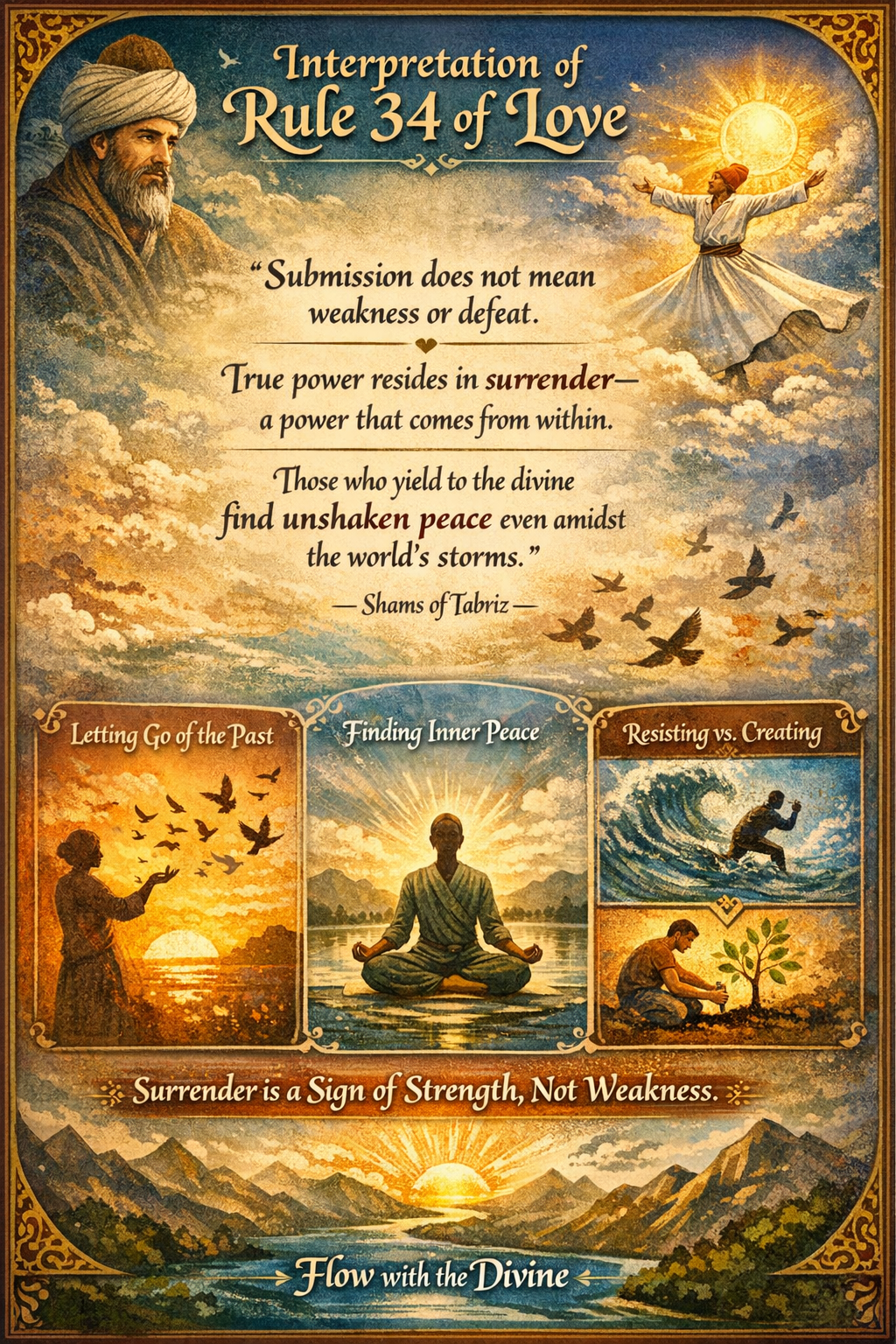
Rule Number 34 — Submission does not mean being weak or passive. It leads to neither fatalism nor capitulation. Just the opposite. True power resides in submission a power that comes within. Those who submit to the divine essence of life will live in unperturbed tranquillity and peace even the whole wide world goes through turbulence after turbulence.
– Shams, to himself
Context - This
rule appears when Shams leaves Konya and Rumi and departs for Damascus. During
his time there, he reflects on the quality of submission or surrender, which he
associates with his friend Francis. It is in this phase that Shams recalls this
rule.
Interpretation
within the Story - As Shams realizes that his work in Konya, particularly with
Rumi, has come to completion, he chooses to move on toward his next
destination. While speaking about Francis’s ability to surrender, he is perhaps
also contemplating his own capacity for submission.
For most people, it is difficult to move on and let go when one phase of life ends and another begins. Through both his words and actions, Shams demonstrates that the quality of surrender must be cultivated in order to flow effortlessly with the river of consciousness.
Deeper
Interpretation Beyond the Story - As discussed earlier, most of us struggle to
accept change. Letting go or moving on from a situation once its time has
passed is rarely easy.
It is in such moments that our ability to surrender is truly tested. It reveals the extent to which we trust and accept the divine will in every situation.
A person who is truly surrendered to the divine remains in a state of peace and tranquility. Such a person believes that nothing can go wrong when every event unfolds through the divine. Even in the face of extreme circumstances, they remain detached and unaffected internally. Their inner peace stays untouched by external chaos. This represents the highest level of surrender, which naturally brings the highest level of peace. This is one of the key teachings of this rule.
However, the human mind often raises a question: how is this different from passive resignation or even self-destructive tendencies?
To understand this, we must look at how energy functions within us.
Energy within the body cannot remain stagnant. It must find expression, either in a creative or a destructive way.
If I lack the ability to surrender in a given situation, what happens?
Naturally, I begin to resist. I try to fight and change the situation, either outwardly or within myself. In doing so, I go against the divine will, indicating a lack of trust. Moreover, no matter how much I resist, I cannot overcome the larger flow of existence.
Most importantly, my energy gets misdirected into destructive channels through this resistance.
On the other hand, if I accept the situation as it is, surrender to it, and stop resisting the divine will, my accumulated energy begins to move in a creative direction. I start creating something new—something that can help me navigate the situation, improve my present circumstances, or shape a better future.
Therefore, the lesson of surrender is essential for growth. Surrender is never a sign of weakness; it is a sign of inner strength and a step toward a better tomorrow.
Gratitude!!!!


Leave a Reply