
Nirguna Tarot Deck - Structure
Architectural Taxonomy of the Deck
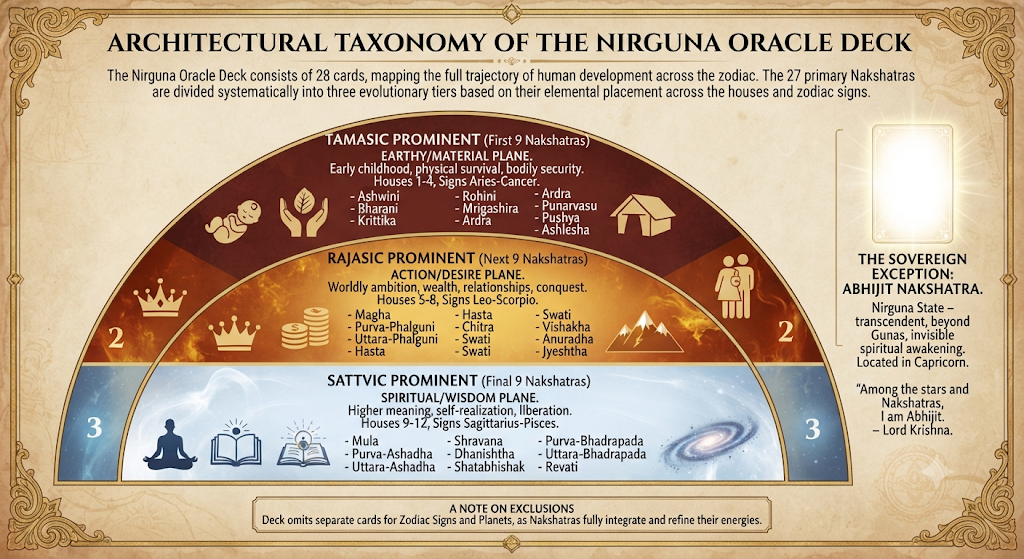
The Nirguna Oracle Deck consists of 28 cards, mapping the full trajectory of human development across the zodiac. The 27 primary Nakshatras are divided systematically into three evolutionary tiers based on their elemental placement across the houses and zodiac signs:
The
Three Operational Tiers of the Nakshatras
|
Tamasic Prominent(First 9 Nakshatras) |
Rajasic Prominent(Next 9 Nakshatras) |
Sattvic Prominent(Final 9 Nakshatras) |
|
• Ashwini • Bharani • Krittika • Rohini • Mrigashira • Ardra • Punarvasu • Pushya • Ashlesha |
• Magha • Purva-Phalguni • Uttara-Phalguni • Hasta • Chitra • Swati • Vishakha • Anuradha • Jyeshtha |
• Mula • Purva-Ashadha • Uttara-Ashadha • Shravana • Dhanishtha • Shatabhishak • Purva-Bhadrapada • Uttara-Bhadrapada • Revati |
The Philosophic Rationalization of the Categories
1.
The Tamasic Tier (Ashwini to Ashlesha)
These first nine Nakshatras occupy the first four signs of the zodiac (Aries to Cancer), reflecting the foundational energy of the 1st, 2nd, 3rd, and 4th houses.
This stage represents the dawn of life: incarnation, gestation within the womb, birth, and early childhood development. At this primordial stage, the soul's absolute priority is basic physical survival, safety, nourishment, and bodily security. We cannot expect a newborn child to focus on worldly conquest or deep spiritual asceticism; the focus is purely on the survival of the physical body. Because Tamas represents the dense material plane and bodily sustenance, these Nakshatras are categorized as predominantly Tamasic. This does not mean they lack higher expressions, but their baseline foundation is rooted in physical incarnation.
2. The
Rajasic Tier (Magha to Jyeshtha)
The next nine Nakshatras span the subsequent four signs (Leo to Scorpio), aligning with the energy of the 5th, 6th, 7th, and 8th houses.
This stage represents the mature individual stepping out into the world. Here, the focus shifts entirely to personal ambition, material accomplishments, the accumulation of wealth, romantic partnerships, and the fulfillment of worldly desires. Because Rajas is the driving engine of desire, manifestation, and outward conquest, these nine Nakshatras are fundamentally Rajasic in their primary baseline expression.
3. The
Sattvic Tier (Mula to Revati)
The final nine Nakshatras occupy the last four signs of the zodiac (Sagittarius to Pisces), corresponding to the spiritual realms of the 9th, 10th, 11th, and 12th houses.
Having navigated material desires and worldly ambitions, the soul naturally begins to turn inward, seeking higher meaning, philosophical truth, self-realization, and universal connection. Because Sattva represents purity, light, wisdom, and spiritual evolution, this final tier is designated as predominantly Sattvic.
The
Sovereign Exception: Abhijit Nakshatra as the Nirguna State
The 28th card in this deck is dedicated to Abhijit Nakshatra, which stands outside the tripartite classification as the representative of the Nirguna State—the ultimate zone of complete spiritual awakening and liberation where all three Gunas are fully transcended.
Astronomically and structurally, Abhijit is located from 6 degree 40 mins to 10 degree 53 mins of Capricorn (overlapping the space between Uttara-Ashadha and Shravana). While some may argue that it should simply be classified as Sattvic due to its location between two Sattvic Nakshatras, I have explicitly categorized Abhijit as Nirguna for three profound reasons:
The Etymological Definition: Abhijit translates literally to "Invincible" or "The One who cannot be conquered." True invincibility belongs solely to the soul that has dropped all desires for conflict, competition, or acquisition. As Lao Tzu beautifully noted: "No one can defeat me, because I am not looking to win over anything or anyone." This is the hallmark of an awakened mind that requires nothing from the external world, knowing that everything necessary is already inherently present.
The Attribute of Invisibility: Within standard structural astrology, a 27-Nakshatra framework is typically used, leaving Abhijit as the "intercalary" or invisible Nakshatra. Spiritual awakening is similarly invisible from the outside. One cannot definitively judge whether a person is enlightened merely by their external appearance or ordinary daily actions; it is an internal, unmanifested reality.
The Divine Declaration: Most authoritatively, in Chapter 10 of the Bhagavad Gita, when Lord Krishna reveals his supreme manifestations throughout the cosmos to Arjuna, he explicitly declares: "Among the stars and Nakshatras, I am Abhijit."
As Abhijit represents The Nirguna State, about which nothing can be said, I am keeping Abhijit Card as blank. Please consider it as your final destination.
Why
This Deck Omits Separate Cards for Signs and Planets?
A common query may arise: Why are there no separate cards for the 12 Zodiac Signs or the 9 Planets?
Excluding
Zodiac Signs
Redundancy: Nakshatras are the intrinsic components that build the Zodiac Signs. Each sign contains exactly 2.25 Nakshatras (for example, Aries is composed of Ashwini, Bharani, and the first quarter of Krittika). By including the Nakshatras, the signs are already fully integrated. Adding separate zodiac sign cards would create unnecessary repetition and dilute the clarity of the reading.
Interpretive Precision: Sign-based Gunas are determined solely by their ruling planets. For instance, because Mars is a traditionally Tamasic planet, Aries and Scorpio are categorized as Tamasic signs. However, looking closely at Scorpio reveals that its internal Nakshatras (like Anuradha and Jyeshtha) carry highly Rajasic, ambitious qualities. Relying strictly on sign-based Gunas limits our interpretive depth, whereas a Nakshatra-based framework provides far greater psychological precision.
Excluding
Planets
Planets possess fixed Gunas: the Sun, Moon, and Jupiter are inherently Sattvic; Mercury and Venus are Rajasic; Mars, Saturn, Rahu, and Ketu are Tamasic.
If we utilized independent planetary cards, Mars would always be interpreted strictly through a restrictive, heavy Tamasic lens. However, in our Nakshatra framework, the energy of Mars is distributed across three distinct Mansions: Mrigashira (Tamasic), Chitra (Rajasic), and Dhanishtha (Sattvic). This allows the energy of Mars to express itself across the entire evolutionary spectrum, giving the reader far deeper insight into how to refine that specific planetary power.
Gratitude!!!


Leave a Reply