
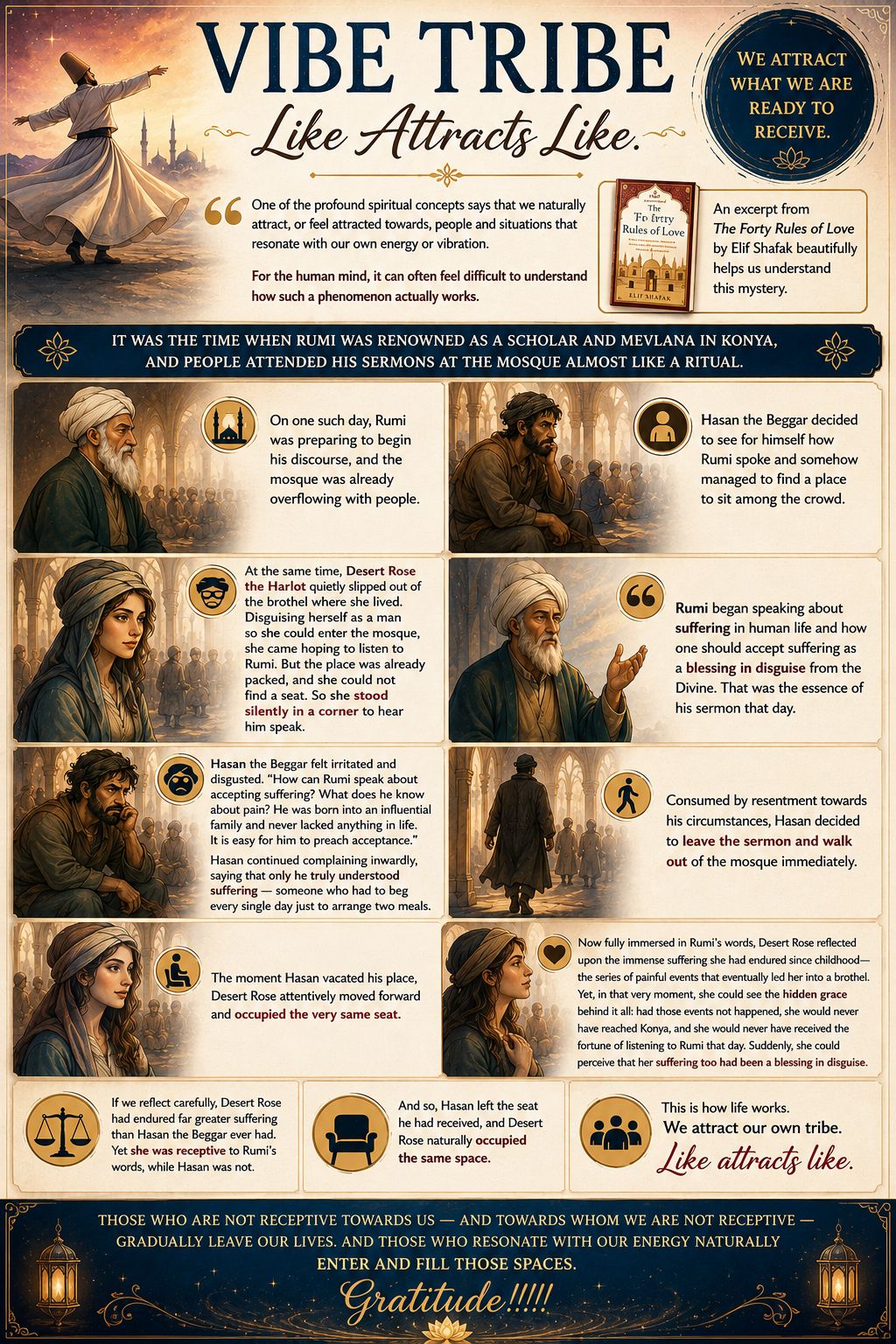
Vibe Tribe – Like Attracts Like
One of the profound spiritual concepts says that we naturally attract, or feel attracted towards, people and situations that resonate with our own energy or vibration.
For the human mind, it can often feel difficult to understand how such a phenomenon actually works.
An excerpt from The Forty Rules of Love by Elif Shafak beautifully helps us understand this mystery.
It was the time when Rumi was renowned as a scholar and Mevlana in Konya, and people attended his sermons at the mosque almost like a ritual.
On one such day, Rumi was preparing to begin his discourse, and the mosque was already overflowing with people.
Hasan the Beggar decided to see for himself how Rumi spoke and somehow managed to find a place to sit among the crowd.
At the same time, Desert Rose the Harlot quietly slipped out of the brothel where she lived. Disguising herself as a man so she could enter the mosque, she came hoping to listen to Rumi. But the place was already packed, and she could not find a seat. So she stood silently in a corner to hear him speak.
Rumi began speaking about suffering in human life and how one should accept suffering as a blessing in disguise from the Divine. That was the essence of his sermon that day.
Hasan the Beggar felt irritated and disgusted. Within himself he thought, “How can Rumi speak about accepting suffering? What does he know about pain? He was born into an influential family and never lacked anything in life. It is easy for him to preach acceptance.”
Hasan continued complaining inwardly, saying that only he truly understood suffering — someone who had to beg every single day just to arrange two meals.
Consumed by resentment towards his circumstances, Hasan decided to leave the sermon and walk out of the mosque immediately.
The moment Hasan vacated his place, Desert Rose attentively moved forward and occupied the very same seat.
Now fully immersed in Rumi’s words, Desert Rose reflected upon the immense suffering she had endured since childhood — the series of painful events that eventually led her into a brothel. Yet, in that very moment, she could see the hidden grace behind it all: had those events not happened, she would never have reached Konya, and she would never have received the fortune of listening to Rumi that day. Suddenly, she could perceive that her suffering too had been a blessing in disguise.
If we reflect carefully, Desert Rose had endured far greater suffering than Hasan the Beggar ever had. Yet she was receptive to Rumi’s words, while Hasan was not.
And so, Hasan left the seat he had received, and Desert Rose naturally occupied the same space.
This is how life works. We attract our own tribe. Like attracts like.
Those who are not receptive towards us — and towards whom we are not receptive — gradually leave our lives. And those who resonate with our energy naturally enter and fill those spaces.
Gratitude!!!!


Leave a Reply