
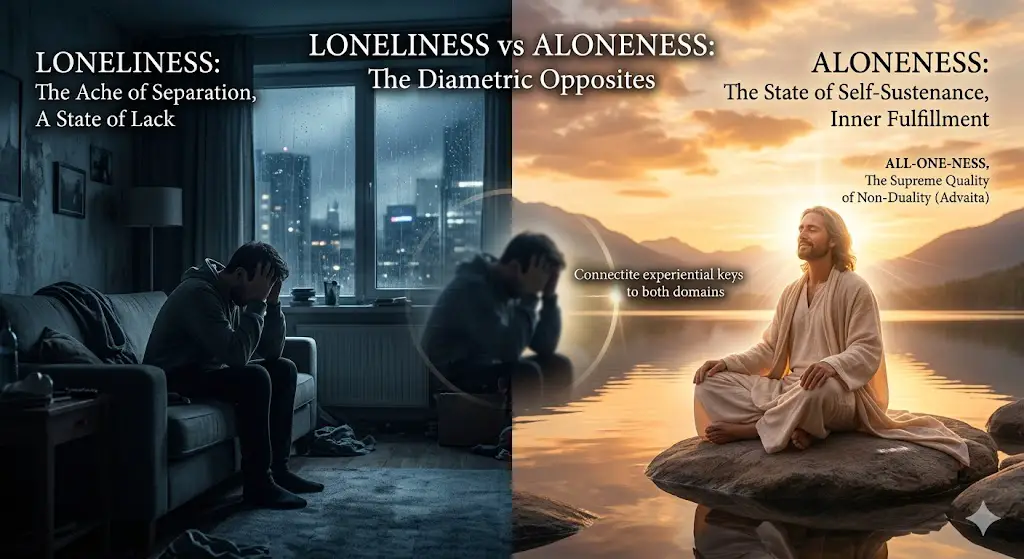
Loneliness vs Aloneness
In the discourse of contemporary spirituality, it is remarkably common to hear enlightened mystics speak of Loneliness versus Aloneness. Across various eras, the teachings of self-realized masters consistently critique the melancholy of loneliness while exalting the sublime state of aloneness.
For the uninitiated, this distinction often becomes a source of deep confusion. To the average mind operating within worldly conditioning, these two concepts appear to be entirely synonymous, representing the same state of physical isolation.
Osho demystifies this by stating that loneliness and aloneness are not merely distinct; they are diametric opposites. They exist at completely opposite ends of the qualitative spectrum, making any direct comparison between them impossible.
This assertion can compound our initial confusion because we lack the experiential reference point to comprehend such a vast polarity. We naturally project our familiar experiences of loneliness onto the concept of aloneness, treating them as identical simply because we have never consciously inhabited the latter.
The resolution to this confusion lies in recognizing that the master speaking on this theme is a Self-Realized Soul. Having traversed both sides of the human spectrum, they likely experienced the heavy weight of human loneliness in the formative chapters of their lives, followed by the luminous expanse of aloneness post-enlightenment. Because they hold the experiential keys to both domains, they can effortlessly contrast their polar-opposite natures. The seeker, knowing only loneliness, projects that singular memory onto aloneness, thereby giving rise to intellectual confusion.
To dissolve this ambiguity, let us examine the core theoretical architecture of both states.
Loneliness: The Dynamic of Separation
Because loneliness is a state with which the vast majority of humanity is intimately acquainted, it serves as our natural starting point.
Loneliness is an emotional state characterized by a desperate, outer-directed need for companionship. In this frequency, our own presence feels insufficient, hollow, or intolerable. We operate under the psychological illusion that the presence of an external "other" is mandatory to validate our existence and make life worth living. It is a state of lack, rooted in the perceived ache of separation.
Aloneness: The State of Self-Sustenance
In stark contrast, spiritual masters define aloneness as a state of absolute inner fulfillment, where you are completely sufficient unto yourself.
In this state, the desperate, clawing need for another person to fill an internal void completely evaporates.
- If a companion walks alongside you on your life's journey, they are warmly welcomed.
- If they choose to depart, you remain anchored in a natural state of letting go.
To be precise, it is not even a conscious act of "letting go," because a person established in aloneness never engages in psychological clinging in the first place. They welcome entry without attachment, and bless departures without grief, remaining beautifully established in a neutral, unshakeable center.
The Mechanics of the Fully Realized Mind
How does a self-realized individual maintain this absolute equanimity?
The Realization of Impermanence: They possess a vivid, real-time understanding of the transient nature of cosmic law. They know that whatever undergoes a beginning is mathematically bound to an ending. Every individual who enters your life will inevitably depart, or you will depart from them. Your only true sovereign choice is whether to meet this reality with graceful receptivity or futile resistance. You can choose to let them go with an open heart or weep over the inevitable; the cosmic outcome remains unchanged.
The Sovereignty of Inner Joy: They understand that their joy is not dependent on external variables. They know that no external entity has the power to grant them sustainable happiness, which simultaneously means no one possesses the power to make them unhappy. They recognize that happiness and sorrow are not caused by external events, but are entirely determined by our internal responses to life's situations. By remaining fully receptive to reality as it unfolds, inner peace remains undisturbed.
The Esoteric Etymology of Aloneness
From a deeper spiritual perspective, we can uncover a hidden truth through a creative linguistic breakdown of the word itself:
Aloneness = Al + One + Ness
Al: Can be understood as the phonetic and esoteric shortening of "All," or used definitively to signify "The."
One: Represents the ultimate state of Advaita, or Non-Duality.
Ness: Denotes a distinct quality or state of being.
Thus, the deeper spiritual anatomy of Aloneness reveals itself as:
All-One-Ness OR The-One-Ness
The supreme quality of being consciously unified with the One.
In the world's great mystical traditions, this precise realization is called Awakening, Liberation, or Enlightenment. In this state of consciousness, the illusion of the isolated ego dissolves, revealing the intricate interconnectedness of the entire cosmos. You recognize yourself not as an isolated fragment, but as an expression of the vast, intelligent Whole.
This explains why Self-Realized Masters speak of this theme with such frequency and passion. Having directly merged with the oneness of existence, they see the golden thread connecting all names and forms.
Naturally, a being established in this realization cannot experience the agonizing yearning of loneliness or the urge to cling to another. They are acutely aware that everything and everyone is already eternally integrated. Whether a person approaches, stays, or leaves your physical proximity, you both remain inextricably connected within the greater cosmic matrix.
This is why loneliness and aloneness are perfect energetic opposites:
In Loneliness, the mind perceives itself as isolated and fragmented, sparking a frantic craving for external company to bridge the gap.
In Aloneness, the soul resides in the absolute awareness that regardless of physical distance, all beings are eternally unified within the Source.
From the absolute, apex view of non-dual spirituality, one might even say that if there is truly only ONE, the concepts of connection and separation become entirely obsolete. Who is there left to connect with, and who is there to separate from?
However, this sublime state of aloneness cannot be fully comprehended through intellectual gymnastics; it can only be realized through the actual experience of Liberation or Enlightenment. Prior to that shift in consciousness, the mind will likely remain tangled in confusion, misinterpreting the formless beauty of aloneness through the painful lens of loneliness.
For those seeking to explore this profound distinction further, Osho articulates the dynamic between loneliness and aloneness with pristine clarity here: https://www.oshotimes.com/insights/loneliness-and-aloneness/
Gratitude!!!


Leave a Reply